Your Toothbrush is a Biofilm Hub: 5 Reasons a Rinse Isn’t Enough
Your Toothbrush is a Biofilm Hub: 5 Surprising Reasons Your Rinse-and-Dry Routine Isn't Enough
Step into your bathroom and you are entering a tropical microclimate. Between the steam from the shower and the lingering dampness on the vanity, it is the ultimate incubator for microorganisms. We meticulously clean our hands and kitchen counters, yet the one item we put in our mouths twice a day—our toothbrush—is often the most neglected.
While we might assume a quick splash under the tap leaves our bristles ready for the next use, the reality is far grittier. According to EPA-Registered source data, standard rinsing is an insufficient defense against the pathogen-neutralizing needs of modern oral care. Your toothbrush isn't just a cleaning tool; without proper intervention, it’s a biofilm hub.
1. Your Body Already Makes the Solution
The most sophisticated weapon against toothbrush contamination isn't a synthetic chemical birthed in a test tube; it is a molecule your own immune system has used for millennia. Hypochlorous Acid (HOCl) is naturally produced by human white blood cells as the frontline defense against invading bacteria and viruses.
What makes Danolyte HOCl revolutionary is the ability to replicate this biocompatible molecule using a simple, elegant process of pure salt, water, and electricity. By utilizing stabilized HOCl, we aren't just cleaning; we are mimicking a natural internal response.
"HOCl mimics the way our own bodies fight infection. It deserves a spot in your daily routine—especially if you’re looking for a deeper, cleaner, and more natural approach to oral health."
2. The "Invisible Slime" (Biofilm) vs. Danolyte
Bacteria on damp bristles don’t just lounge on the surface; they build a fortress. This invisible slime, or biofilm, is a resilient protective layer where pathogens thrive, particularly at the base of the bristles. Standard mouthwashes or boiling water often fail to penetrate this sticky matrix.
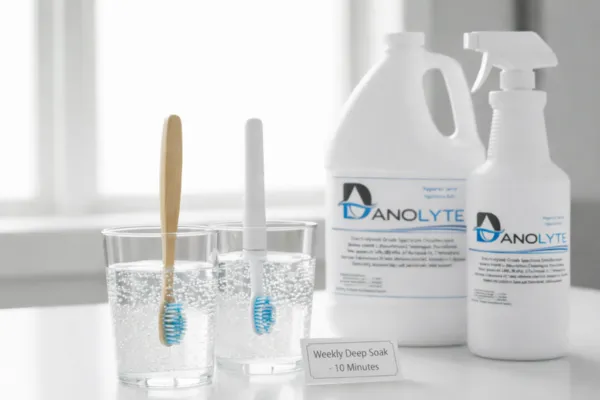
The stakes go beyond "bad breath." Oral bacteria are increasingly linked to systemic health issues, including heart disease and diabetes. Danolyte, a hospital-grade disinfectant, is specifically formulated to disrupt these biofilms. While a daily spray is essential, the ultimate disruptor is the Weekly Deep Soak: submerge your brush head in Danolyte for 5 to 10 minutes to neutralize the microorganisms a rinse leaves behind.
3. A Hospital-Grade Clean That’s Safe Enough to Ingest
We are often taught that a disinfectant must be "harsh" to be "effective." Danolyte shatters this myth. It is an EPA-registered hypochlorous acid disinfectant designed for hard, non-porous surfaces and personal hygiene applications. It offers medical-grade efficacy without the need for gloves, masks, or warning labels.
Unlike bleach or alcohol-based sanitizers, HOCl is non-irritating and leaves no toxic residue. If a trace amount of Danolyte remains on the bristles, it is completely harmless. You get the peace of mind of a hospital-level clean without the chemical baggage.
4. The 60-Second "No-Rinse" Efficiency
In the rush of a morning routine, high-tech UV gadgets are often abandoned. Efficiency requires frictionless solutions, which is why the 60-second Daily Spray method is so effective:
Rinse away visible debris with tap water.
Spray the bristle head liberally with Danolyte HOCl.
Wait 60 seconds (the contact time required to neutralize the majority of oral pathogens).
Dry: Store the brush upright. Because it’s a no-rinse formula, there's no need to wash it off before your next use.
5. The "Active Power" Secret (Proper Storage)
HOCl is a delicate substance. Its active germ-killing strength is highly light-sensitive. If you transfer the solution to a clear bottle or leave it in direct sunlight, the molecular bonds will degrade, stripping the formula of its efficacy.
To maintain your "toothbrush station," Danolyte must be stored in its original opaque container or a dedicated dark-colored spray bottle. This sensitivity is a small trade-off for a substance that is as effective as bleach but as safe as salt water.
Conclusion: A Smarter Approach to Oral Care
Transitioning to a cleaner lifestyle shouldn't require compromising on power. By moving beyond the inadequate rinse-and-dry routine and embracing Danolyte HOCl, you are protecting your oral health and your systemic well-being. If you wouldn't eat off a plate that had only been rinsed with water, why are you comfortable putting a "rinsed-only" toothbrush in your mouth?
