Disinfection vs Sterilization: What’s the Difference and What You Actually Need at Home & Work
Disinfection vs Sterilization: The Difference That Saves You Time, Money, and Panic-Scrubbing
If you’ve ever said “I sterilized the kitchen,” congratulations—you’ve joined the world’s largest cleaning club: people who use the word sterilize when they mean disinfect.
And honestly? It’s not your fault. Marketing blurbs, social posts, and “cleaning hacks” have mashed these words into one vague concept: kill the germs.
But disinfection and sterilization are not interchangeable. The difference matters because it changes:
What product should you use?
How long does it need to stay wet?
What risk are you actually reducing?
and whether you’re doing smart hygiene… or expensive theater.
Let’s make it simple, practical, and (finally) clear.
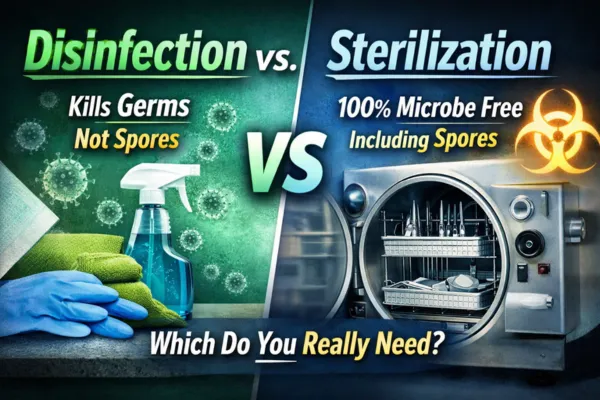
Disinfection kills many or most disease-causing germs (viruses and bacteria) on surfaces, but may not kill bacterial spores. Sterilization destroys all microorganisms, including spores, using validated processes like steam (autoclave), specialized gas, or other medical/lab methods. (Healthline)
What is disinfection?
Disinfection is a chemical process used on hard, non-living surfaces to kill viruses and bacteria (and reduce infection risk). The EPA regulates surface disinfectants in the U.S., and they must meet specific efficacy standards. (US EPA)
Key nuance: Disinfectants may not reliably kill bacterial spores unless the label specifically says so. (Healthline)
What is sterilization?
Sterilization is the highest level of microbial control—a sterile item is completely free of living microorganisms and viruses. In healthcare and labs, it’s typically achieved via steam, gas, plasma, radiation, or other validated methods. (Office of Research Safety)
Disinfection vs Sterilization: Side-by-Side
CategoryDisinfectionSterilizationGoalReduce pathogens to prevent infectionEliminate all microbial life (including spores)Typical useHomes, offices, schools, gyms, facilitiesMedical/lab instruments, critical devicesMethodsEPA-registered chemical disinfectantsAutoclave (steam), gas, plasma, radiation, etc.Spore killingNot guaranteedRequiredRegulated by (U.S.)EPA (for surfaces)FDA for liquid chemical sterilants/high-level disinfectants for critical/semi-critical devices; CDC provides guidance (CDC)
The “When Do I Need Which?” Decision Rule
Here’s the practical filter that keeps you sane:
You usually need disinfection when…
Someone is sick in the home,
You’re cleaning high-touch areas (handles, faucets, phones),
You’re in a business setting with lots of shared surfaces,
You’re dealing with spills/contamination on noncritical surfaces. (CDC)
You need sterilization when…
An item will contact sterile tissue or internal body sites,
it’s a critical medical device (think: surgical instruments),
You’re following a lab/clinical protocol that requires sterility. (CDC)
This is why hospitals don’t “spray and pray” surgical tools. They follow structured frameworks (like Spaulding classification) to match the method to the risk. (CDC)
The Missing Step Most People Skip: Cleaning Comes First
Here’s the unsexy truth:
If the surface is dirty, disinfection is less effective.
The EPA and CDC emphasize that you should pay attention to label instructions—especially contact time (how long the surface must stay visibly wet). (US EPA)
So the correct sequence is usually:
Clean (remove dirt/organic matter)
Disinfect (keep it wet for the label’s contact time)
Let dry (or rinse if the label requires it for specific uses)
Where Does HOCl Fit In?
HOCl = Hypochlorous Acid (a powerful oxidizer)
Hypochlorous acid is widely discussed in the scientific literature as a strong oxidant with broad antimicrobial activity; it’s even produced by immune cells (neutrophils) as part of the body’s defense system. (PMC)
In plain English: HOCl works by oxidative damage—it disrupts key structures and functions microbes need to survive. (PMC)
Why that matters for real-world cleaning
People are tired of the tradeoff:
“This disinfects… but it smells like a chemistry lab.”
“This is safer… but does it actually work?”
HOCl-based disinfectants are popular because they’re positioned as a strong efficacy + friendlier use experience option, depending on the product’s registration and label directions.
And that brings us to Danolyte.
What Danolyte Disinfectant Is (and What It Isn’t)
Danolyte Disinfectant is an EPA-registered disinfectant based on hypochlorous acid (HOCl). https://danolyteglobal.com/danolyte-disinfectant
From the Danolyte Disinfectant page and product detail listings, it’s positioned around:
EPA Registered Disinfectant status
EPA List N references (useful for shoppers comparing registered disinfectants)
“0 harsh chemicals” messaging and high customer recommendation claims
Food-contact friendly positioning on product details
Important clarity (this builds trust):
Danolyte Disinfectant is a surface disinfectant—it’s built for disinfection tasks, not as a replacement for true sterilization protocols (autoclaves, validated medical device sterilants, etc.). That distinction is exactly what CDC guidance is trying to protect people from misunderstanding. (CDC)
How to Use a Disinfectant Correctly (So You Don’t “Disinfect-Wash” Your Effort Down the Drain)
Most people don’t fail because they chose the “wrong product.”
They fail because they do one of these:
Spray → wipe immediately (contact time = 2 seconds… nice fragrance though)
Disinfect a dirty surface (germs protected by grime)
Miss high-touch zones (phones, remote controls, handles)
Never check the label (the label is the law for EPA products) (CDC)
The simple pro method:
Pre-clean if visibly dirty
Apply until the surface is fully wet
Keep it wet for the contact time on the label (US EPA)
Allow to air dry (or follow any rinse directions for food-contact surfaces)
Common Use Cases: Disinfect or Sterilize?
Kitchen counters after raw chicken
Disinfect. Clean first, then use an EPA-registered disinfectant and follow the contact time. (US EPA)
Kids’ toys/school supplies
Often, clean + sanitize is enough unless someone is sick; disinfect in higher-risk periods. EPA distinguishes sanitizing vs disinfecting (sanitizers aren’t intended to kill viruses). (US EPA)
Medical instruments (anything invasive)
Sterilize using proper medical protocols—not a household surface disinfectant. (Office of Research Safety)
Bathrooms, gyms, office high-touch areas
Disinfect (especially during illness spikes). (CDC)
“But I Want Sterile at Home…” (The gentle reality check)
Wanting “sterile” makes emotional sense—especially if you have kids, aging parents, or a compromised immune system in the home.
But in practice:
Sterilization is a process, not a vibe.
It requires validated equipment, conditions, and often heat/gas methods. (Office of Research Safety)
For almost every household and everyday business scenario, proper cleaning + correct disinfection is the right, evidence-based lane. (CDC)
FAQ (Google-friendly)
Does disinfecting mean the same thing as sterilizing?
No. Disinfecting kills many or most germs on surfaces; sterilizing eliminates all microorganisms, including spores. (Healthline)
Why does “contact time” matter?
Because the disinfectant needs time to work. EPA guidance emphasizes keeping the surface wet for the label’s contact time. (US EPA)
Who regulates disinfectants and sterilants in the U.S.?
EPA regulates surface disinfectants; FDA regulates liquid chemical sterilants and high-level disinfectants for critical/semi-critical medical devices; CDC publishes guidance and frameworks. (CDC)
What’s the difference between sanitize and disinfect?
EPA notes sanitizing is not intended to kill viruses; disinfecting kills viruses and bacteria on surfaces and is held to more rigorous testing requirements. (US EPA)
What is Danolyte Disinfectant?
Danolyte Disinfectant is an EPA-registered hypochlorous acid (HOCl) disinfectant, positioned for hospital-grade surface disinfection with “0 harsh chemicals” messaging and EPA registration information shown on its site. https://danolyteglobal.com/danolyte-disinfectant
The Bottom Line (and the smart way to shop)
If you remember only one thing, remember this:
Sterilization is for critical tools and validated processes. Disinfection is for the real world—homes, offices, schools, and everyday surfaces where you want to cut infection risk without turning your space into a hazardous chemical zone. (CDC)
If you’re looking for an EPA-registered HOCl disinfectant designed for routine surface disinfection, Danolyte Disinfectant is built for that lane. https://danolyteglobal.com/products-list
