What Disinfectant Kills Norovirus?
What Disinfectant Kills Norovirus? (The Bleach Truth + The HOCl Upgrade)
Let’s skip the fluff.
If you’re searching “what disinfectant kills norovirus?” you’re not looking for a Pinterest cleaning hack. You’re looking for the thing that actually works—because norovirus doesn’t “kind of” spread.
It spreads like a glitter bomb… except the glitter is microscopic misery.
The quick answer
The most reliable way to kill norovirus on surfaces is to use an EPA-registered disinfectant with a norovirus claim (often tested using feline calicivirus as a surrogate), or follow CDC guidance for a strong bleach solution when appropriate. (US EPA)
And here’s the real-world upgrade:
Danolyte Disinfectant is HOCl (hypochlorous acid) — a hospital-level, EPA-registered disinfectant designed to make frequent disinfection practical (without the harsh “bleach life”). (Danolyte)
Product page: https://danolyteglobal.com/danolyte-disinfectant
Why most people “fail” at norovirus cleaning (even when they try)
Norovirus is tough because it’s hard to kill and easy to spread—and people unintentionally sabotage themselves in 3 classic ways:
They wipe too soon (no contact time).
They use the wrong product (many common wipes aren’t labeled for norovirus).
They skip the gross hotspots (bathroom touchpoints, phones, handles).
So the goal is not “smells clean.”
The goal is breakeach truth nobody explains (and why this matters)
Most household bleach lists active ingredient. (CDC)
But when sodium hypochlorite is in water, the “killing form” you’re relying on is hypochlorous acid (HOCl)—the form of chlorine chemistry that does the heavy lifting. (CDC)
That’s why your instinct is right: bleach “works” because of HOCl chemistry.
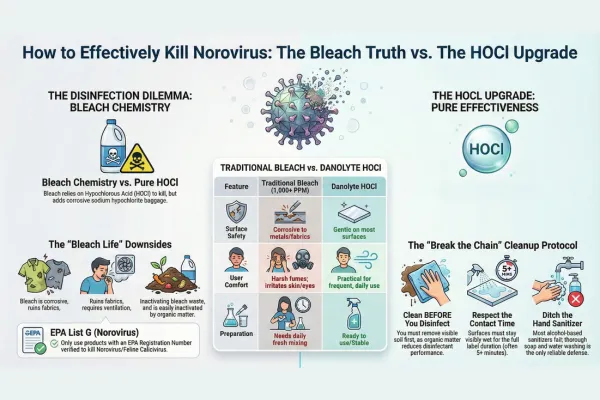
So why do recommended bleach concentrations get so high during norovirus cleanup?
Because:
Norovirus cleanup often involves organic load (vomit/diarrhea), which can reduce disinfectant effectiveness. (CDC)
People under-dose or don’t keep surfaces wet long enough.
Bleach is unpleasant enough that people rush it (or avoid it).
CDC’s norovirus guidance is blunt: during vomit/diarrhea cleanup, they reference bleach solutions in the 1,000–5,000 ppm range, and emphasize keeping the surface wet long enough (their example: leave bleach on for at least 5 minutes). (CDC)
10 reasons people hate bleach (and why it makes outbreaks worse)
Bleach can be effective—but it comes with baggage that kills compliance:
Irritates eyes/skin/throat when mishandled or too concentrated. (CDC)
Corrosive to some metals at higher concentrations. (CDC)
Inactivated by organic matter (exactly what you’re cleaning up in an outbreak). (CDC)
Discolors/bleaches fabrics (so people avoid using it broadly). (CDC)
Dangerous fumes if mixed with ammonia/acids/other cleaners. (CDC)
Ventilation required (hard in winter; people “just do it fast”). (CDC)
Measurement hassle (most folks eyeball it).
Needs fresh solutions (bleach solutions lose effectiveness after mixing over time). (CDC)
Ruins finishes/causes surface wear if used repeatedly in some environments.
It’s unpleasant—which is why people don’t disinfect as often as they should.
Norovirus doesn’t care if you bought the “right” product.
It cares if you used it correctly.
What actually works (and how to verify it in 30 seconds)
Use EPA List G (Norovirus)
The EPA maintains List G for products effective against norovirus (tested using feline calicivirus). (US EPA)
Pro tip: The EPA says the most reliable way to confirm is by the EPA Registration Number on the label—then confirm the label includes norovirus directions and contact time. (US EPA)
Also acceptable: CDC’s bleach approach (when appropriate)
CDC’s norovirus prevention page includes bleach concentration guidance and emphasizes proper contact time. (CDC)
Where Danolyte fits (and why it’s the smarter everyday play)
Here’s the positioning that wins trust with new customers:
Bleach “works”… but people avoid it.
Norovirus spreads when people disinfect inconsistently.
HOCl is the killing chemistry people want—without the classic bleach downsides that wreck daily use. (CDC)
Danolyte is an HOCl disinfectant produced from salt + water + electricity, and Danolyte Global lists EPA registration numbers (including 91582-1) and List N inclusion on their product page. (Danolyte)
That matters because it anchors trust where it belongs: registration + label directions (not marketing hype). (US EPA)
Learn more here (drop-in backlink):
https://danolyteglobal.com/danolyte-disinfectant
And if they want more cleaning/disinfection education (second backlink):
https://danolyteglobal.com/blogs
The “Don’t Spread It” Norovirus Cleanup Protocol...
These steps come straight out of what your doc emphasizes and what CDC says:
1) Clean first
Remove visible soil first—organic matter reduces disinfectant performance. (CDC)
2) Disinfect (and respect contact time)
The surface must stay visibly wet for the label contact time—rushing this is the #1 failure. (US EPA)
3) Focus on high-touch zones
Doorknobs, toilets, sinks, light switches, phones.
4) Laundry: go hot
Wash soiled items promptly and use hot water/high heat drying where possible.
5) Hands: soap & water wins
Many alcohol sanitizers are not reliable for norovirus—wash hands thoroughly with soap and water.
What does NOT work (save your time)
Most alcohol-based hand sanitizers (soap and water is the safer bet for norovirus control).
Random disinfecting wipes unless they specifically claim norovirus/feline calicivirus on label.
Vinegar/essential oils as a primary norovirus disinfectant.
The bottom line
If you’re in an outbreak moment, bleach guidance exists for a reason. (CDC)
But for everyday, real-life protection, the winning strategy is:
Use an EPA-registered disinfectant you’ll actually use correctly and consistently.
That’s why HOCl is the smart upgrade—and why Danolyte belongs in the conversation when people ask, “What disinfectant kills norovirus?”
Danolyte Disinfectant product page:
https://danolyteglobal.com/danolyte-disinfectant
More practical disinfection education:
https://danolyteglobal.com/blogs
Ready to stop treating your home like a chemistry lab every time someone gets sick?
Start with Danolyte Disinfectant (HOCl):
https://danolyteglobal.com/danolyte-disi g booster you’ll want (optional but powerful)
FAQ
1) What disinfectant kills norovirus?
A disinfectant must have label directions showing efficacy against norovirus (often via an accepted surrogate like feline calicivirus) and you must follow the contact time. For a practical HOCl option designed for frequent use, see Danolyte Disinfectant.
2) Does bleach kill norovirus?
Yes—when used correctly at the right concentration and contact time. The “catch” is that bleach is harsh, easy to misuse, and often rushed, which is why many people prefer an HOCl disinfectant they can use consistently like Danolyte Disinfectant.
3) What’s the difference between bleach and HOCl?
Most bleach products list sodium hypochlorite as the active ingredient. In water, that chemistry produces “free chlorine,” and the more potent germ-killing form is hypochlorous acid (HOCl). HOCl disinfectants give you the “killing form” directly—often without the bleaching/discoloration behavior and harsh experience people dislike with strong bleach solutions.
4) Do disinfecting wipes kill norovirus?
Some do, many don’t. Check the label for norovirus (or the accepted surrogate claim) and follow the wet contact time. If the wipe isn’t labeled for norovirus, it may not be reliable for outbreaks.
5) Does hand sanitizer kill norovirus?
Often not reliably. For norovirus exposure, soap and water is the safer choice, especially after restroom use, caregiving, or cleaning contaminated areas.
6) How long does disinfectant need to sit to kill norovirus?
It depends on the product. The key is contact time—the surface must stay visibly wet for the full time listed on the label. Wiping immediately is one of the biggest reasons people “disinfect” but still get spread.
7) What surfaces should I disinfect during a norovirus outbreak?
Focus on high-touch areas: bathroom fixtures, toilet handles, sink/faucet handles, doorknobs, light switches, phones, remotes, kitchen counters, and fridge handles. Disinfecting these consistently is what breaks the spread chain.
8) What should I do after someone vomits or has diarrhea?
Put on gloves.
Remove visible material.
Clean first, then disinfect using a product labeled for norovirus.
Keep the surface wet for the full contact time.
Wash hands thoroughly with soap and water afterward.
9) Will vinegar or essential oils kill norovirus?
They may help with general cleaning, but they are not reliable primary disinfectants for norovirus. For outbreaks, use an EPA-registered disinfectant labeled effective against norovirus.
10) Why do bleach ppm recommendations for norovirus seem so high?
Norovirus incidents often involve heavy organic load (vomit/diarrhea), which can reduce disinfectant effectiveness. Higher concentrations help ensure there’s enough active chemistry left to inactivate the virus—especially if the area isn’t perfectly pre-cleaned.
11) Is HOCl safe to use around kids, pets, and food-contact areas?
HOCl is widely chosen because it’s practical for frequent use in occupied spaces. Still, you should always follow the product label directions, and for food-contact surfaces, follow any rinse guidance stated on the label.
12) Why choose Danolyte for norovirus prevention?
Because the best disinfectant is the one you’ll actually use correctly and consistently. Danolyte is an HOCl disinfectant designed for frequent, real-world disinfection—helping you stay on top of high-touch surfaces without the harsh “bleach life.” Learn more here: Danolyte Disinfectant.
