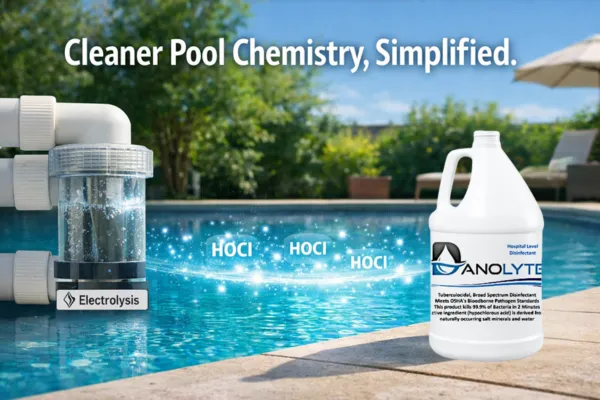
How Saltwater Pools Work: The HOCl “Secret” Behind Cleaner Water
Saltwater Pools, HOCl, and the Big Myth: “No Chemicals”
If you’ve been told a saltwater pool is chemical-free, I have news:
That’s like saying an espresso machine is “coffee-free” because it doesn’t use instant packets.
A saltwater pool creates chlorine. It just makes it on-site from salt using a salt chlorine generator (aka salt cell). (Pinch A Penny)
And what does that chlorine become in water?
Hypochlorous acid (HOCl) — the active sanitizer that actually does the work.
So the real conversation isn’t “salt vs chlorine.”
It’s this:
Do you want to keep sanitizing your pool by storing, handling, and dosing traditional pool chemicals…
Or would you rather use an HOCl-based approach that’s cleaner, simpler, and easier to live with?
How Saltwater Pools Work (In Plain English)
A saltwater system dissolves a small amount of salt (sodium chloride) in the pool. Then, a salt cell uses electrolysis to split those molecules and generate “chlorine in water” forms, including hypochlorous acid (HOCl). (CircuPool)
Important myth-buster:
Saltwater pools are still chlorine pools
They sanitize with chlorine the same way other pools do—the difference is how the chlorine gets introduced (generated vs poured in). (Pinch A Penny)
The HOCl “Aha Moment”: What You Really Wanted All Along
Most pool owners think they’re “adding chlorine.”
But what you actually want is HOCl, because that’s the form doing the sanitizing heavy lifting in properly balanced water. (Wikipedia)
That’s why pH matters so much.
The CDC recommends keeping pool pH between 7.0 --- 7.8 and maintaining at least 1 ppm free chlorine (and notes typical ranges commonly used for healthy swimming). (CDC)
In other words:
If the pH is off, your sanitizer's performance drops, and the risk of irritation increases.
If free chlorine is too low, sanitation suffers.
If combined chlorine builds up (in the form of chloramines), you get that “pool smell” and irritated eyes.
The Hidden Problem with Salt Cells: Output Isn’t “Set It and Forget It”
Saltwater is awesome… until it isn’t.
Real-world chlorine/HOCl production from a salt system can fluctuate based on:
salt level
generator settings and runtime
higher chlorine demand (heat, sunlight, pool parties)
mechanical or cell issues
dilution from rain/splash-out (Wikipedia)
That’s why saltwater pools still require monitoring and water chemistry management—just like “regular” pools.
The Danolyte Difference: HOCl — But Produced to a Higher Standard
Here’s where your point lands:
A saltwater pool generates chlorine/HOCl as part of its operation…
…but Danolyte is built around controlled HOCl production with purpose-built generator technology and quality control.
Danolyte Global describes manufacturing its own HOCl generators and controlling the process to produce fresh, high-quality HOCl solutions with strict quality control. (Danolyte Global)
So instead of:
buying tabs
handling shock
storing harsh chemicals
fighting “why is my water off again?” weekends
You’re moving toward:
HOCl as the center of the system—like saltwater pools—but with better control and consistency.
“Instead of Using Chemicals, Can I Just Use Danolyte in My Pool?”
Let’s be responsible and clear:
For pool water sanitation, always follow local codes and use only products/systems that are approved/labeled for treating pool water. (Pools are regulated environments, and directions matter.)
What you can do immediately (and where Danolyte is a no-brainer):
Use Danolyte HOCl to disinfect the entire pool environment
Because the “pool problem” isn’t only the water—it's everything people touch:
handrails, ladders, steps
pool decks and coping
lounge chairs, tables, outdoor kitchens
restrooms, handles, trash lids
floats, goggles, pool toys
Danolyte positions its product as an EPA-registered disinfectant and food-contact friendly, designed for effective disinfection without harsh chemical tradeoffs. (Danolyte Global)
So you get the “clean pool experience” people actually feel—without turning your backyard into a chemical cabinet.
If You Still Search “How Much Chlorine to Add to Pool Calculator”…
Here’s the practical guidance people want before they trust you:
Test free chlorine and pH
Keep pH in the CDC range 7.0–7.8 (CDC)
Maintain at least 1 ppm free chlorine (typical ranges often cited are 1–4 ppm) (CDC)
Dose based on pool gallons + current FC + target FC (use a calculator you trust)
Then bring the reader back to your main point:
Your goal isn’t “more chlorine.”
Your goal is effective HOCl sanitation—with fewer harsh chemicals and less drama.
The Simple Next Step
If you’re ready to move away from the old “store chemicals, dump chemicals, smell chemicals” routine…
Start where it’s easiest to win fast:
1) Upgrade the pool environment first (surfaces + high-touch areas)
Learn more about Danolyte Disinfectant (HOCl): (Danolyte Global)
2) Order Danolyte here
Product ordering page: (Danolyte Global)
