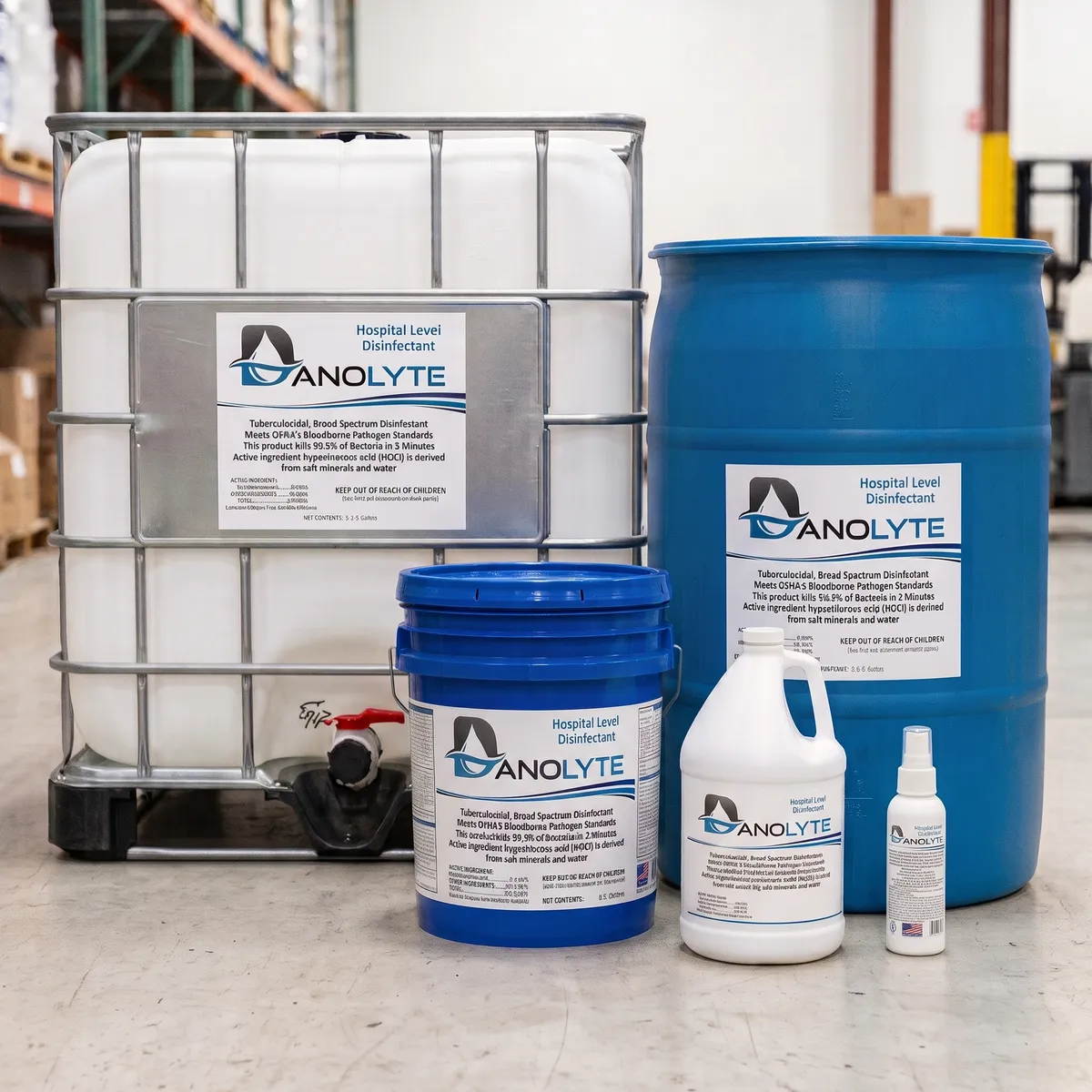
EPA Reg. No. 91582-1 · Hospital grade · Made fresh in the USA
Danolyte Disinfectant Label Guide
Everything Danolyte hypochlorous acid (HOCl) disinfectant can do, in plain language: what it kills, where to use it, how to mix it, and what's never in it.
Overview
Danolyte Disinfectant is a ready-to-use, hospital-grade, EPA-registered hypochlorous acid (HOCl) solution. In one step, it cleans, deodorizes, sanitizes, and disinfects, and it breaks down common household allergens on hard surfaces.
Its active ingredient is derived from naturally occurring salt minerals and water. It has no fragrance, no dyes, no alcohol, no phenols, no phosphates, and no VOCs, and leaves no harmful or harsh chemical residue. It's gentle enough for use in nurseries and is registered for use everywhere from hospitals and nursing homes to homes, cars, and pet areas.
It's for anyone who wants to control their own environment: the surfaces they touch, the rooms they live in and the things they carry with them. Danolyte eliminates bacteria and viruses* that hide where you touch, breathe, work, play, and live.
*On hard, non-porous surfaces when used as directed.
At a glance
| Strength | Gentleness | Convenience |
|---|---|---|
| Hospital-grade and veterinarian-grade disinfectant | Gentle enough for use in nurseries | Ready to use at full strength (500 ppm); dilute only if you choose |
| EPA Reg. No. 91582-1 | Fragrance, dye, alcohol, phenol, and VOC-free | No rinse formula; no wiping required |
| Broad spectrum; bactericidal, virucidal*, tuberculocidal, parvocidal | Leaves no harmful or harsh chemical residue | One-step cleaner and disinfectant |
| Kills C. diff spores* | Low odor: the smell of clean | 3-in-1 formula: cleaner, odor eliminator and sanitizer |
| Kills Pandemic 2009 H1N1 influenza A (formerly called swine flu)* | No worries about pet licking after cleaning | Disinfectant to go |
| Breaks down dust mite matter, pet dander and pollen | Breaks down into saline solution | For daily use, on high-touch surfaces |
| Tested to AOAC germicidal spray method for hospital disinfectants | Non-flammable, non-greasy, non-sticky | Multi-surface sanitizer |
| Meets OSHA Bloodborne Pathogens surface disinfection recommendations | Contains no phosphates | Made in the USA |
Also on the label: germicidal spray; staphylocidal and pseudomonocidal; kills common household bacteria and viruses*; kills odor-causing bacteria; leaves surfaces disinfected and sanitized; designed for practical use; a new generation of protection; inspired by how you want to disinfect; the answer to your disinfecting and sanitizing needs.
What the label means for you
Disinfectant labels are written for regulators. Here's what Danolyte's means in everyday terms.
| On the label | What it means for you |
|---|---|
| EPA-registered (Reg. No. 91582-1) | Danolyte's maker proved to the EPA that it kills the germs listed on its label. You can look the number up yourself. |
| Hospital grade | It passed the tests required of disinfectants used in hospitals, including against Staph and Pseudomonas. |
| Broad spectrum | It works against bacteria, viruses, spores, and yeast, not just one type of germ. |
| Tuberculocidal | It kills the bacteria that cause tuberculosis, one of the hardest germs to kill on a surface. |
| Kills C. diff spores | Spores have a tough shell that many disinfectants can't get through. Danolyte is registered to kill them. |
| Sanitize vs. disinfect | Sanitizing kills 99.9% of bacteria on a surface. Disinfecting kills the listed germs, including viruses. Danolyte does both, depending on how you mix it. |
| Contact time | How long a surface needs to stay wet for the label's kill claims. It's in the Directions for use. |
| *On hard, non-porous surfaces | Claims cover surfaces like counters, plastic, glass, and sealed tile, not fabric or carpet. |
| Gentle enough for use in nurseries | The label says so in those words, alongside its hospital-grade claims. |
| Leaves no harmful or harsh chemical residue | After it works, it breaks down into saline solution, so there's no chemical film left behind. |
| Phenol-free, alcohol free, VOC-free | Phenols and alcohol are disinfecting ingredients in many household sprays, and VOCs are chemicals that evaporate into the air. Danolyte contains none of them. |
Around your home and on the go
Every item below is a hard, non-porous use site or surface listed on the Danolyte label. Items marked † touch food or mouths: sanitize them with diluted Danolyte (no rinse needed), or rinse with water after disinfecting at full strength.
| Where | What you can use it on |
|---|---|
| Kitchen | Counters, tables, sinks, faucets, cabinets and handles, exterior of appliances, refrigerator and freezer interiors†, microwaves†, stovetops, cutting boards†, dishes and utensils†, lunch boxes†, garbage cans |
| Bathroom | Toilet seats, rims and bowls, exterior toilet surfaces, bathtubs, showers, tiled walls, vanities, mirrors, bathroom fixtures, soap dispensers |
| Nursery and kids' rooms | Cribs, bassinets, changing tables, diaper pails, playpens, toys and baby toys, bath toys, toy boxes, highchairs and trays†, booster chairs, potty chairs, children's car seats, activity centers, play tables, baby bottles†, breast pump parts† |
| Living areas and bedrooms | Doorknobs, light switches, TV remotes, phones, tablets, laptops, keyboards and monitors, desks, chairs, lamps, piano keys and musical instruments, floors, walls, windows, humidifiers, dehumidifiers, exterior surfaces of air vents |
| Personal items | Eyeglasses, goggles, earbuds, headphones, headsets, helmets, face masks and face shields, combs, hair clips, nail clippers, scissors, razors, tweezers, dental retainers and appliances†, water pick tips† |
| Home health equipment | CPAP machines and the external surfaces of CPAP masks, neti pots, glucometers, blood pressure monitors, wheelchairs, support bars and rails, plastic mattress covers |
| Pets | Pet areas, kennels, cages, litter boxes, pet toys, pet bowls and feeding dishes†. No worries about pet licking after cleaning |
| Car and on the go | Cars and personally owned vehicles, RVs, campers, boats, airplanes, trains, grocery carts and checkout areas, stroller handles, gyms, locker rooms, hotels, offices, elevator buttons, hand railings |
| Outdoors | Decks, outdoor furniture (not wood frames or upholstery), playgrounds, children's wading pools, siding, garages |
More from the label:
- Bedrooms and laundry: plastic or vinyl mattress and pillow covers, hampers, laundry rooms, basements, attics and garages
- Sports and activity gear: helmets, protective pads and mats, gymnastics and wrestling mats, climbing walls, bowling balls, athletic equipment
- Fish, birds and small pets: aquariums, cages, pet toys and pet areas
- Public places: use it in public or common places where bacteria and viruses* may be of concern, like restrooms, stall doors, hand dryers, soap dispensers, hand railings and elevator buttons
- Worry-free use in baby rooms, nurseries, kennels, litter boxes, and pet areas
- Cross-contamination: helps reduce the risk of cross-contamination between treated hard, non-porous surfaces, like moving from a raw-meat cutting board to the counter
- More home health items: prosthetics, scales, bed pans, shower fixtures, stethoscopes, otoscopes, external surfaces of respirator and ventilator equipment
- Electronics: TVs, telephones, microphones, dictating and telecommunications equipment, sealed electronics
- Kids' play: riding toys, play sets, playground equipment
- Outdoors and garden: planters, picnic tables, outdoor furniture (not wood frames or upholstery), house siding
Things that go in your mouth: The label lists dental retainers, dental appliances, dentures, night guards, mouth guards, water pick tips, baby bottles, medicine droppers, breast pump parts, musical instrument mouthpieces, mouth harps, vape and e-cigarette tanks, pipes, chopsticks and utensils, and the external surfaces of CPAP masks and respirator equipment. To sanitize them, soak or spray with 1 part Danolyte to 1.5 parts water for 60 seconds, then let them air dry; no rinse needed. To disinfect at full strength, rinse with drinking water afterward.
Fresh flowers: Mix 1 to 2 ounces of Danolyte per quart of water in a vase to help cut flowers last longer, or spray the diluted solution on plants and flowers to control bacteria growth.
Allergens it breaks down
Danolyte breaks down and destroys common indoor allergens on the hard surfaces where they settle:
- Dust mite matter and dust mite debris
- Cockroach matter and cockroach debris
- Pet dander, dog dander and cat dander, including pet dander found in dust
- Pollen particles
How to use it: Mix 1 part Danolyte with 1.5 to 4 parts water (100 to 200 ppm). Spray, mop, or wipe it onto floors, counters, windowsills, shelves, and other hard surfaces; keep them wet for 2 minutes, and let them air dry. Use it daily, or as often as you like.
Use it where dust, dander, and pollen collect: bedrooms, living rooms, pet areas, entryways, and the exterior surfaces of air vents, humidifiers, and dehumidifiers.
Odors it eliminates and stains it cleans
Odors: Danolyte deodorizes by killing the bacteria that cause odors, so it eliminates odors at their source instead of covering them up. It eliminates:
- Pet odors, like urine, feces, vomit, and that "wet dog" smell
- Food odors, like garlic, fish, and onion
- Smoke, body, and other foul odors
- Odors caused by bacteria and yeast in the kitchen and bathroom
Stains and soils: As a cleaner, it removes bathtub ring, beverage, coffee, tea and fruit stains, blood, body oils, dead skin, dirt, fingerprints, food residue, grease, mildew stains, mold stains, rust, urine and vomit stains, fecal matter and other organic matter.
What it kills
Danolyte is a broad-spectrum, hospital-grade disinfectant. It is effective against non-enveloped viruses* and is broadly antiviral, capable of inactivating both enveloped and non-enveloped viruses.* Used as directed on hard, non-porous surfaces, it kills:
| Category | Organisms on the EPA label |
|---|---|
| Bacteria | MRSA (methicillin-resistant Staphylococcus aureus); VRE (vancomycin-resistant Enterococcus faecalis); Staphylococcus aureus (staph); E. coli; Salmonella enterica; Listeria monocytogenes; Pseudomonas aeruginosa; Enterobacter aerogenes; Bordetella bronchiseptica (kennel cough) |
| Spores | Clostridioides difficile (C. diff) spores |
| Mycobacteria | Mycobacterium bovis BCG (tuberculosis, TB) |
| Respiratory and cold viruses* | Influenza A (H1N1), including Pandemic 2009 H1N1 (formerly called swine flu); respiratory syncytial virus (RSV), a cause of respiratory infection in infants; rhinovirus, a leading cause of the common cold; adenovirus |
| Stomach viruses* | Norovirus (Norwalk virus); rotavirus, the virus that causes diarrhea |
| Bloodborne pathogens* | HIV-1; hepatitis C (HCV) |
| Animal viruses* | Canine parvovirus; canine distemper; bovine viral diarrhea virus |
| Yeast | Candida albicans |
It is effective in the presence of a 5% organic soil load (blood serum), and it kills HIV-1 on pre-cleaned surfaces soiled with blood or body fluids, per label directions. Contact times for each organism are in the Directions for use.
*On hard, non-porous surfaces when used as directed.
How it's made, and why fresh matters
Danolyte is made by Electro-Chemical Activation (ECA). Weak salt brine passes through the electrolytic cells of our own Danolyte generators and becomes an oxidizing solution with antimicrobial properties, in a single-stage process using only water, salt, and low-energy electricity.
We produce it at a near-neutral pH of 6.5, where the main antimicrobial agent is hypochlorous acid, with a minimum of 500 ppm free available chlorine. After use, it breaks down into a saline solution.
Because it's made electrochemically from salt and water in a single-stage process, Danolyte is cost-effective to produce, uses little energy, and can be made with a controlled pH and chlorine level for medical, dental, veterinary, institutional, hospitality, industrial, commercial, and residential use.
Why fresh matters: HOCl naturally breaks down over time. That's why our family makes Danolyte every weekday in Overland Park, Kansas, and ships it the day it's made, instead of storing it in a warehouse. Every container shows its production date. We have designed and built our own HOCl generators since 2015.
Healthcare, facilities and other industries
| Setting | Label-listed sites and surfaces |
|---|---|
| Hospitals and medical | Patient rooms, ICUs, NICUs, PICUs, newborn nurseries, emergency and operating rooms, isolation rooms, exam rooms, dialysis and outpatient clinics; bed rails, IV poles, gurneys, wheelchairs, external surfaces of medical equipment, ultrasound transducers and ventilators, high-touch surfaces. May be used to pre-clean or decontaminate critical or semi-critical devices before sterilization or high-level disinfection |
| Dental | Dental offices, chairs, operatory surfaces and countertops |
| Long-term and home care | Assisted living, nursing and retirement homes, hospices, home health care settings |
| Veterinary and animal care | Veterinary clinics and hospitals, kennels, grooming facilities, pet hotels and shops, animal housing, aquariums, aviaries, livestock and equine facilities, zoos |
| Schools and childcare | Daycares, preschools, nursery schools, schools, colleges, dormitories, school buses, playrooms |
| Hospitality and recreation | Hotels, resorts, cruise ships, gyms and health clubs, locker rooms, athletic equipment and mats, arenas, stadiums, theaters, casinos, bowling alleys, waterparks, skating rinks |
| Workplaces and public spaces | Offices, call centers, factories, retail stores, supermarkets, churches and synagogues, funeral homes, shelters, correctional facilities, public restrooms |
| Transportation | Ambulances, fleet vehicles, trucks, trains, airplanes, boats, yachts |
Ready-to-use lines are labeled for consumer, residential, household, commercial, hospital, dental, nursery, veterinarian, hospitality, cruise line, public transportation, janitorial and industrial use. Danolyte is also labeled for water treatment in oil and gas production.
Blood and body fluid cleanup: Danolyte kills HIV-1 and hepatitis C on surfaces soiled with blood or body fluids, and meets surface disinfection recommendations under OSHA's Bloodborne Pathogens Standard. Wear disposable gloves when handling blood or body fluids, clean them away, then apply Danolyte and let it stand 10 minutes.
Food contact, food service and hand antiseptic
Food contact sanitizer: Danolyte is an effective multi-purpose sanitizer for food contact surfaces and for food and beverage processing equipment. Diluted 1 to 1.5 with water (200 ppm), it sanitizes against Staphylococcus aureus and Salmonella enterica with no rinse required. It's acceptable as a sanitizer for all hard, non-porous surfaces in and around food processing areas, and is used in kitchens, homes, restaurants, schools, dairies, breweries, wineries, and food processing plants.
Hand antiseptic (FDA Food Code): Danolyte meets the requirements of section 2-301.16, Hand Antiseptics, of the U.S. Public Health Service FDA Food Code. Spray Danolyte on your hands as an alcohol-free hand antiseptic, at home or on the go. It has no alcohol, no fragrance, and no dyes. A hand antiseptic solution used as a hand dip must be kept clean and at a strength equivalent to at least 100 ppm chlorine: 1 part Danolyte to 4 parts water.
Glove dip and boot wash: Dilute 1 to 4 with water (100 ppm). Remove debris from rubber gloves or boots, then dip or thoroughly coat them, keep them wet for at least 60 seconds, and let them air dry.
Chlorine equivalency: Danolyte meets AOAC Available Chlorine in Disinfectants chlorine equivalency against Salmonella enterica and Staphylococcus aureus.
More food-industry uses: sanitizing conveyor belts and equipment in fishery, milk, wine, citrus, potato, and ice cream processing plants, including to reduce odors in the processing area; reducing bacteria on filling equipment; sanitizing bottling and pre-mixed beverage dispensing equipment; and sanitizing food processing equipment under 21 CFR 178.1010 and the FDA Food Code sanitization recommendations.
Pets
Danolyte is a veterinarian-grade disinfectant that's gentle on the spaces your pets share with you. There are no worries about pet licking after cleaning, and it's worry-free in kennels, crates, litter boxes, and pet areas.
- Fragrance-free: the formula will not irritate your dog's or pet's nose
- Kills canine parvovirus, distemper, and Bordetella (kennel cough)* on hard surfaces
- Eliminates pet odors at the source, like urine, feces, vomit, and that "wet dog" smell
- Breaks down pet, dog, and cat dander on hard surfaces, including dander found in dust
- Use it on: kennels, cages, crates, litter boxes, pet toys, aquariums, grooming tables and pet areas. For pet bowls and feeding dishes, sanitize with diluted Danolyte (no rinse needed) or rinse with fresh water after full-strength disinfecting
*On hard, non-porous surfaces when used as directed.
Cleaning up after a pet accident? Clean the mess first with HydroxyClean, then disinfect hard surfaces with Danolyte. See the two-step pet cleanup guide.
Farms, livestock and animal premises
Danolyte is labeled for livestock, swine, equine and poultry facilities, chicken and bird coops, feed lots, animal housing, kennels, aquariums, raptor aviaries, reptile and amphibian areas, petting zoos and animal life-science labs. It kills canine parvovirus, distemper, and Bordetella (kennel cough)* and is a veterinarian-grade disinfectant.
Surfaces: stalls, pens, cages, feed racks, troughs, automatic feeders, fountains, waterers and watering appliances, and the external surfaces of veterinary equipment.
Everyday use: spray stalls, pens, cages and coops as often as you like; Danolyte is worry-free in kennels, litter boxes and pet areas.
For a full barn, coop or kennel deep-clean, the label's steps are: clear out animals, feed, litter and manure; wash surfaces with soap or detergent; apply Danolyte at full strength and keep surfaces wet for 10 minutes, soaking halters, ropes, forks and shovels too; let everything dry before animals return; and rinse feeders, troughs and waterers with fresh water before refilling. Full directions are on the product label.
*On hard, non-porous surfaces when used as directed.
Oil and gas
Danolyte is also labeled to control non-public-health microorganisms, odors, and hydrogen sulfide in oil and gas production.
| Application | How much | What it does |
|---|---|---|
| Frac water | 5 gal Danolyte per 995 gal frac water (2.5 ppm), or enough for a 0.1 to 0.5 ppm residual | Controls anaerobic, aerobic, and sulfate-reducing bacteria; protects fracturing fluids, polymers, and gels |
| Sour wells | Slug dose 168 gal at 500 ppm (or 42 to 420 gal), daily, weekly or monthly | Controls odors and microorganisms, reduces hydrogen sulfide gas, helps restore well integrity |
| Produced and flowback water | 21 gal per 979 gal (10.5 ppm), or a 0.5 ppm residual | Slows growth of microorganisms |
| Heater treaters, hydrocarbon storage and gas storage wells | 126 gal at 500 ppm, or a 0.5 ppm residual in the water phase | Controls microorganisms, odors, and hydrogen sulfide; reduces tank corrosion |
| Water flood injection water | 21 gal per 979 gal (10.5 ppm), or a 0.1 to 0.5 ppm residual | Controls microorganisms and slime in pipelines |
| Oil and gas transmission lines | Slug dose 42 to 420 gal at 500 ppm, daily or weekly | Controls sulfate-reducing bacteria, reduces microbiologically influenced corrosion, removes slime and associated sessile bacteria |
Directions for use
It is a violation of federal law to use this product in a manner inconsistent with its labeling. Danolyte comes ready to use at full strength (500 ppm), which disinfects, sanitizes, and deodorizes. Diluting is optional: the label gives weaker mixes for food-contact sanitizing, allergens, glass, glove and hand dips, and flowers. Pre-clean heavily soiled areas first. Chlorine test strips may be used, as an option, to check the strength of diluted solutions and ensure proper strength.
| Use | Mix | How |
|---|---|---|
| Clean and disinfect hard, non-porous surfaces | Ready to use (500 ppm) | Wipe, spray, mop or dip. Keep surfaces wet for 10 minutes (2 minutes for influenza A H1N1 strain A/Virginia, Staphylococcus aureus, Enterobacter aerogenes, and hepatitis C), then air dry |
| Kill C. diff spores | Ready to use | Wear gloves; clean away fecal matter first, then apply and let stand 10 minutes |
| Surfaces soiled with blood or body fluids (HIV-1) | Ready to use | Wear disposable gloves when handling blood or body fluids. Clean them away first, then apply and let stand 10 minutes |
| Toilet bowls, urinals and bidets | Ready to use | Empty the bowl, apply under the rim and over all surfaces, brush, keep wet 10 minutes before flushing |
| Water-sensitive electronics (phones, keyboards, remotes) | Ready to use, or 1:1.5 to sanitize | Power off. Apply with a cloth or sprayer so the surface stays wet without pooling. Don't rinse. Restore power only when fully dry |
| Sanitize non-food contact surfaces | 1 part to 1.5 parts water (200 ppm) | Keep wet 2 minutes; kills 99.9% of bacteria, then air dry |
| Sanitize food contact surfaces | 1 part to 1.5 parts water (200 ppm) | Wash and rinse first, then apply; let stand 60 seconds, then wipe dry or air dry. No rinse required |
| Disinfect food contact surfaces | Ready to use | Rinse with drinking water afterward |
| Deodorize | Ready to use | Spray until thoroughly wet, let stand, then wipe. Or spray surfaces as needed |
| Break down allergens | 1 part to 1.5 to 4 parts water (100 to 200 ppm) | Apply to hard surfaces, keep wet 2 minutes, air dry. Daily or as often as desired |
| Glass, mirrors and windows | 1 part to 4 to 19 parts water (25 to 100 ppm) | Apply, then wipe, squeegee or air dry |
| Glove dip, boot wash, hand dip | 1 part to 4 parts water (100 ppm) | Keep gloves or boots wet at least 60 seconds; keep a hand dip solution clean and at least 100 ppm |
| Cut flowers | 1 to 2 oz per quart of water (15 to 30 ppm) | Add to the vase; change when murky |
Not for use as a terminal sterilant or high-level disinfectant on devices that enter the body or touch mucous membranes. Use for disinfection within 90 days of the production date on the container.
Specifications, storage and surfaces
| Property | Value |
|---|---|
| Active ingredient | Hypochlorous acid, 0.046% |
| Other ingredients | 99.954% |
| Free available chlorine | 500 ppm minimum at production |
| pH | Near neutral, 6.5 at production |
| Appearance | Clear, colorless liquid |
| Odor | Low odor; fresh, clean scent |
| Form | Ready to use |
| ORP | 800 to 900 mV (typical) |
| Electrical conductivity | 1,200 to 1,500 μS/cm (typical) |
Storage: Keep in a closed, dark plastic container away from direct sunlight, in a cool, dry area. Refillable container: refill only with Danolyte.
Surfaces: Will not harm hard, non-porous surfaces, including baked enamel, chrome, Formica, glass, glazed ceramic tile, glazed porcelain and porcelain enamel, laminates, stainless steel, synthetic marble and vinyl tile, or titanium-coated, medical-grade stainless steel. Do not use on steel, aluminum, silver or chipped enamel; prolonged contact with metal may cause pitting or discoloration. Test first in an inconspicuous spot.
Keep away from: ammonia-based products.
What's in it, and what isn't
| Danolyte has | Danolyte never has |
|---|---|
| Hypochlorous acid derived from naturally occurring salt minerals and water | Fragrance or dyes |
| Hospital-grade, broad-spectrum disinfection | Alcohol or phenols |
| A near-neutral pH of 6.5 at production | VOCs, phosphates or phosphorus |
| Low odor: the smell of clean | A flammable formula |
| Breakdown into saline solution after use | Sticky, greasy, harmful or harsh chemical residue |
Safety, regulatory and environmental
Registration: EPA Reg. No. 91582-1; EPA Est. No. 91582-KS-1. Hospital-grade and veterinarian-grade disinfectant, tested according to AOAC efficacy testing requirements and the AOAC germicidal spray method for hospital disinfectants. Meets surface disinfection recommendations under OSHA's Bloodborne Pathogens Standard.
Label statements: Keep out of reach of children. For first aid, call a poison control center or doctor and have the product container or label with you: 1-800-222-1222. For general product information, call the National Pesticide Information Center at 1-800-858-7378.
Environmental commitment:
- Rapidly breaks down entirely to salt water
- Not harmful to septic and wastewater treatment systems
- Contains no phosphorus and no VOCs
- Refillable container; bottles are coded for recyclers (colored HDPE)
- One product to clean, deodorize, sanitize, and disinfect, so fewer products to buy, store, and throw away
Why choose Danolyte
- Control your environment: Eliminates bacteria and viruses* that hide where you touch, breathe, work, play and live, and breaks down dust mite matter, pet dander and pollen on hard surfaces.
- Gentle strength: Hospital-grade and tuberculocidal, kills C. diff spores,* yet gentle enough for use in nurseries, with no fragrance, dyes, alcohol, phenols, phosphates or VOCs.
- One bottle does it all: Cleans, deodorizes, sanitizes, and disinfects, from your kitchen and nursery to your car, your pets' space, and your personal items.
- Made fresh by the people who build the generators: A family business making its own HOCl generators since 2015. Made every weekday in Overland Park, Kansas, and shipped the day it's made.
- Real support: Email the people who make it at [email protected].
- Designed to save you time: use it straight from the bottle at full strength, with no mixing, rinsing, or wiping required, or dilute it if you choose for sanitizing, allergens, glass, and flowers. The convenient way to disinfect, for daily use.
*On hard, non-porous surfaces when used as directed.
Questions and answers
What is Danolyte Disinfectant?
Danolyte Disinfectant is a ready-to-use, hospital-grade, EPA-registered hypochlorous acid (HOCl) solution. In one step, it cleans, deodorizes, sanitizes and disinfects, and it breaks down common household allergens on hard surfaces. Its active ingredient is derived from naturally occurring salt minerals and water.
Is Danolyte EPA-registered?
Yes. Danolyte Disinfectant is EPA Reg. No. 91582-1, made at EPA Est. No. 91582-KS-1. It is a hospital-grade and veterinarian-grade disinfectant, tested according to the AOAC germicidal spray method for hospital disinfectants.
What does Danolyte kill?
Used as directed on hard, non-porous surfaces, Danolyte kills MRSA, VRE, Staph, E. coli, Salmonella, Listeria, Pseudomonas, C. diff spores, tuberculosis (M. bovis BCG), influenza A (H1N1), RSV, rhinovirus, adenovirus, norovirus, rotavirus, HIV-1, hepatitis C, canine parvovirus, canine distemper, Bordetella (kennel cough) and Candida albicans.
How long does Danolyte take to disinfect?
Keep hard, non-porous surfaces wet for 10 minutes, then let them air dry. Influenza A H1N1 (strain A/Virginia), Staphylococcus aureus, Enterobacter aerogenes and hepatitis C take 2 minutes. To sanitize non-food surfaces, keep them wet for 2 minutes.
Do I need to dilute Danolyte?
No. Danolyte comes ready to use at full strength (500 ppm), which disinfects, sanitizes and deodorizes. Diluting is optional, for sanitizing food-contact surfaces, breaking down allergens, cleaning glass, glove and hand dips, and cut flowers.
Can I use Danolyte on food-contact surfaces?
Yes. To sanitize food-contact surfaces, mix 1 part Danolyte with 1.5 parts water (200 ppm), let it stand 60 seconds, and wipe or air dry; no rinse is required. If you disinfect food-contact surfaces at full strength, rinse with drinking water afterward.
Can I use Danolyte on my hands?
Danolyte meets the requirements of section 2-301.16, Hand Antiseptics, of the U.S. Public Health Service FDA Food Code. Spray Danolyte on your hands as an alcohol-free hand antiseptic, at home or on the go. A hand antiseptic solution used as a hand dip must be kept clean and at a strength equivalent to at least 100 ppm chlorine: 1 part Danolyte to 4 parts water.
Can I use Danolyte around pets?
Yes. There are no worries about pet licking after cleaning, and Danolyte is worry-free in kennels, crates, litter boxes and pet areas. Its fragrance-free formula will not irritate your dog's or pet's nose.
Does Danolyte help with allergens?
Danolyte breaks down and destroys dust mite matter and debris, cockroach matter and debris, pet, dog and cat dander, and pollen particles on hard surfaces. Mix 1 part Danolyte with 1.5 to 4 parts water, keep surfaces wet for 2 minutes, and let them air dry.
What surfaces should I avoid?
Danolyte will not harm hard, non-porous surfaces such as glass, chrome, glazed tile, laminate, stainless steel and vinyl. Do not use it on steel, aluminum, silver or chipped enamel; prolonged contact with metal may cause pitting or discoloration.
Why is Danolyte made fresh?
HOCl naturally breaks down over time. Our family makes Danolyte every weekday in Overland Park, Kansas, and ships it the day it's made. Every container shows its production date. Use it for disinfection within 90 days of that date.
Gentle strength you can trust
Hospital-grade disinfecting with nothing harsh left behind, made fresh every weekday by a family business that has built its own HOCl generators since 2015.
Shop Danolyte Disinfectant*On hard, non-porous surfaces when used as directed. Always read and follow label directions.
Danolyte Hospital Level Disinfectant
EPA Label Reg #91582-1